


I’m not sure exactly when I started reading this latest novel, but it’s definitely taken me way longer to finish it than I’d ever intended.
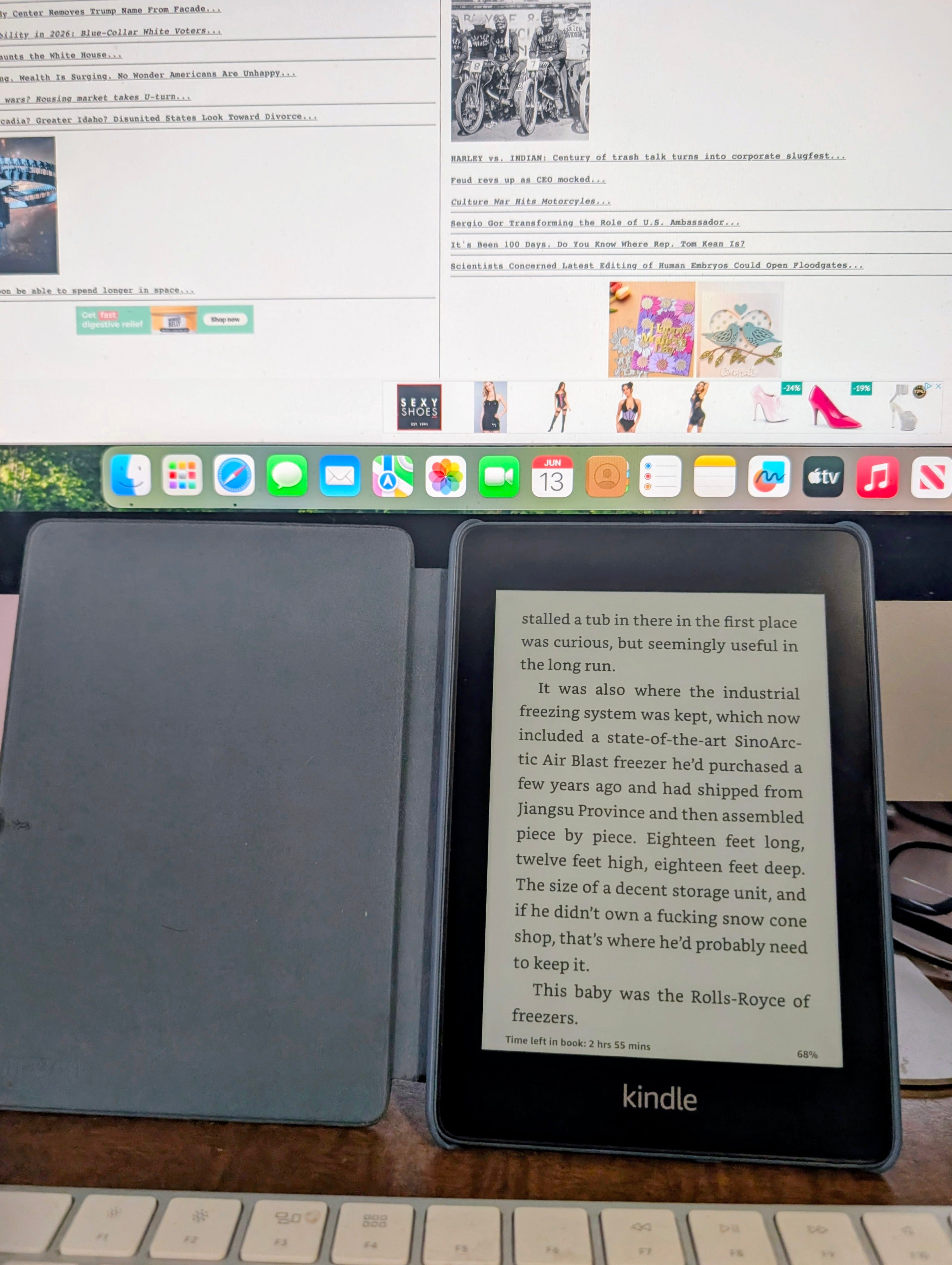
I think a big part of the problem is that I’m way more “well informed” about what’s going on in the world than I really want (or even need) to be.
Ugh.
The funny thing is, I genuinely enjoy reading fiction. And I absolutely hate how I feel when I’m mindlessly scrolling through ‘news’ and social media
So why do I spend so much time scrolling and so relatively little time reading?
That’s the million-dollar question. And if you’re reading this, you're probably suffering from the exact same glitch.
The Battle is Completely Rigged
It turns out there’s some real science behind this. When you try to choose a paperback over your smartphone, you are fighting a heavily rigged war. Cognitive psychologists and neuroscientists look at this as a collision between our ancient evolutionary reward systems and hyper-optimized app design.
When we choose infinite scrolling over immersive fiction, our brains are simply opting for the path of least cognitive resistance. Here is exactly how these apps hack our biology:
The Dopamine Slot Machine: Social media uses what psychologists call a “variable ratio schedule of reinforcement”… the exact same trick that keeps people pulling levers on slot machines. When you pull to refresh a feed, your brain anticipates a reward (a funny video, a striking photo, a notification). Your brain’s dopamine pathway responds most powerfully to unpredictable outcomes.
The “Uphill Hike” of Reading: Regular interaction with fast-paced digital environments trains our brains to process information rapidly but superficially. Reading a novel, on the other hand, demands active mental heavy lifting. Your brain has to decode text, build an internal mental world, and track a narrative over hours or weeks. When you’re tired after a long day, opening a book feels like climbing a steep mountain trail. Scrolling feels like sliding down one.
The Post-Scroll Guilt Hangover: We rarely feel good after a scrolling binge. Because scrolling lacks intentional purpose, it immediately triggers an internal goal conflict. You know you should or want to be spending your time on something more meaningful, like that book on your nightstand. This conflict triggers micro-bursts of guilt and a measurable drop in daily well-being.
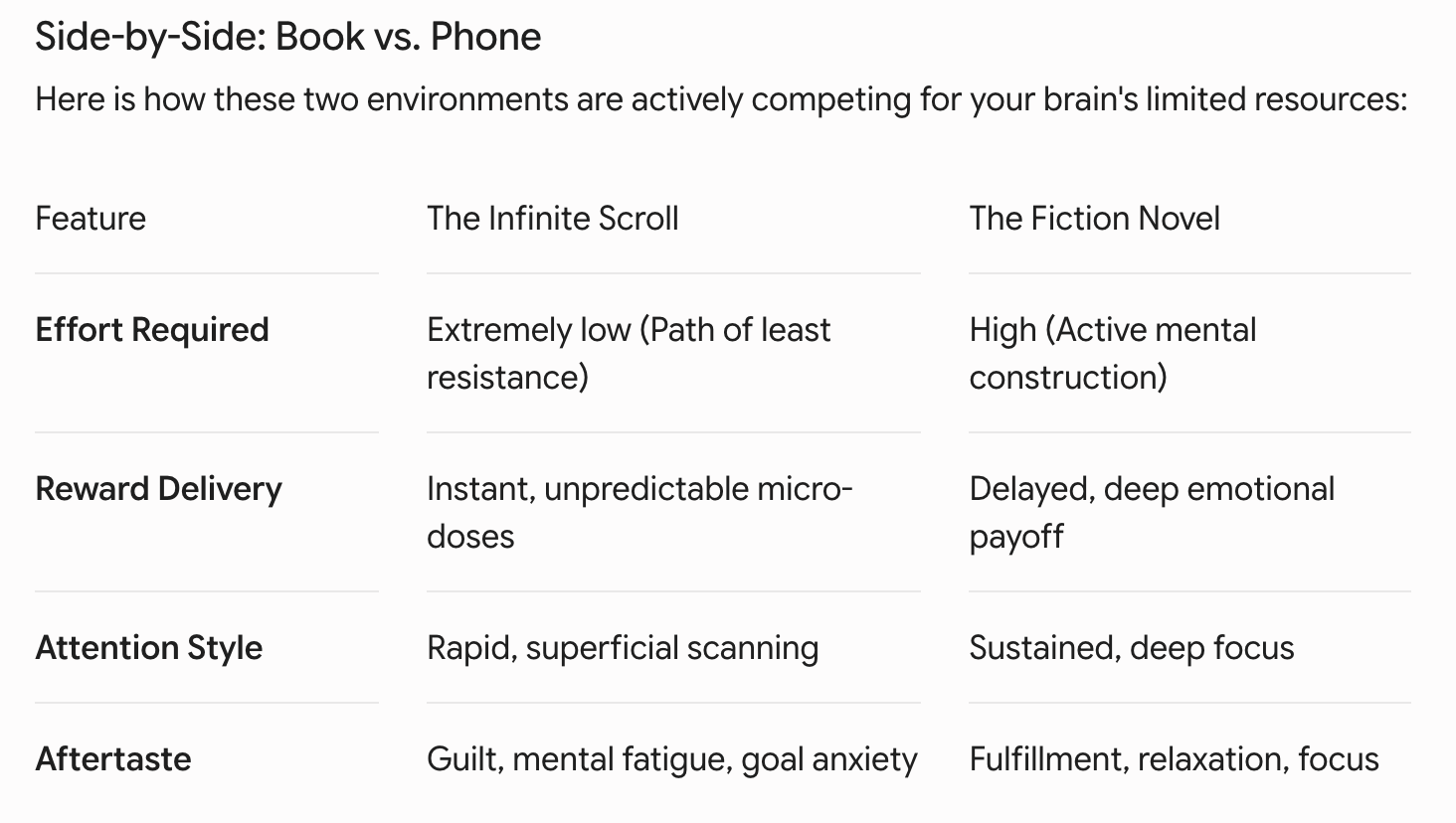
To see how these psychological variables interact in real-time within your own daily routine, you can use this interactive Attention Choice Simulator. By adjusting your current fatigue, the friction of your book, and the algorithmic temptation of your apps, you can visualize exactly why your brain leans toward the path of least resistance.

https://newgreateryou.github.io/attention-simulator/
Borrowing Better Strategies
So what am I trying to do about it?
The simple answer would be to just decide to scroll less and read more. Right? Except my brain is just as taxed and tired as anyone else’s. Resolve alone isn’t going to cut it; I need actual tactics.
Because I’m clearly not alone in this reading rut, I went hunting across Substack to see what tricks other writers are using to reclaim their attention spans. Here are five ideas I am actively stealing:
Lower the friction (via Jess Oliver): Keep your transition into reading as seamless as possible. If your book is sitting right there, uncovered and easy to grab, you’re exponentially more likely to open it.
Train focus like a muscle (via Drishti Pandita): Actively build up your attention span. The goal is to make your focus so deep and steady that the rapid, hyper-fragmented pacing of a social feed actually starts to feel weird and jarring to your brain.
Try “Book Scrolling” (via Sam Rinko at Knowledge Lust): This is a wild strategy to fight fire with fire. Bring three completely different books (different genres, different authors) to one sitting. Read the first until your focus starts to dip, then instead of reaching for your phone, “scroll” to the next book. It tricks your brain’s obsession with novelty but keeps you reading. I’ve always been a one-book-at-a-time guy, but this is clever enough to try.
Read in fragments (via Chibueze Agu): Always carry a book with you and pick it up every single time you feel the mindless, muscle-memory urge to reach for a scroll. Five minutes waiting in a checkout line adds up fast over a week.
Find “unputdownable” recommendations (via Emma at emmareadstoomuch): This sounds obvious, but it’s profound. Hit your friends up specifically for book recommendations that they literally could not put down. A gripping, high-momentum plot makes that cognitive uphill climb a whole lot easier.
The Verdict
The good news is, I now have a wealth of ideas to try.
The bad news? My Kindle has been sitting right next to me the entire time I’ve been working on this article for the last hour. I probably could have made some serious progress on that novel I’m currently three months into. 🙃

Think someone else might enjoy this post?

I'd love to be Kindle reader (Lord knows I've bought a truckload of titles), but the audiobook has won my heart.
I still like reading the actual thing at night (primarily because my wife says I should), but I knock out about 60 books a year sending them right into my ear.
Fun and informative piece! I'll scrounge to find a used one because that eInk is so cool!