


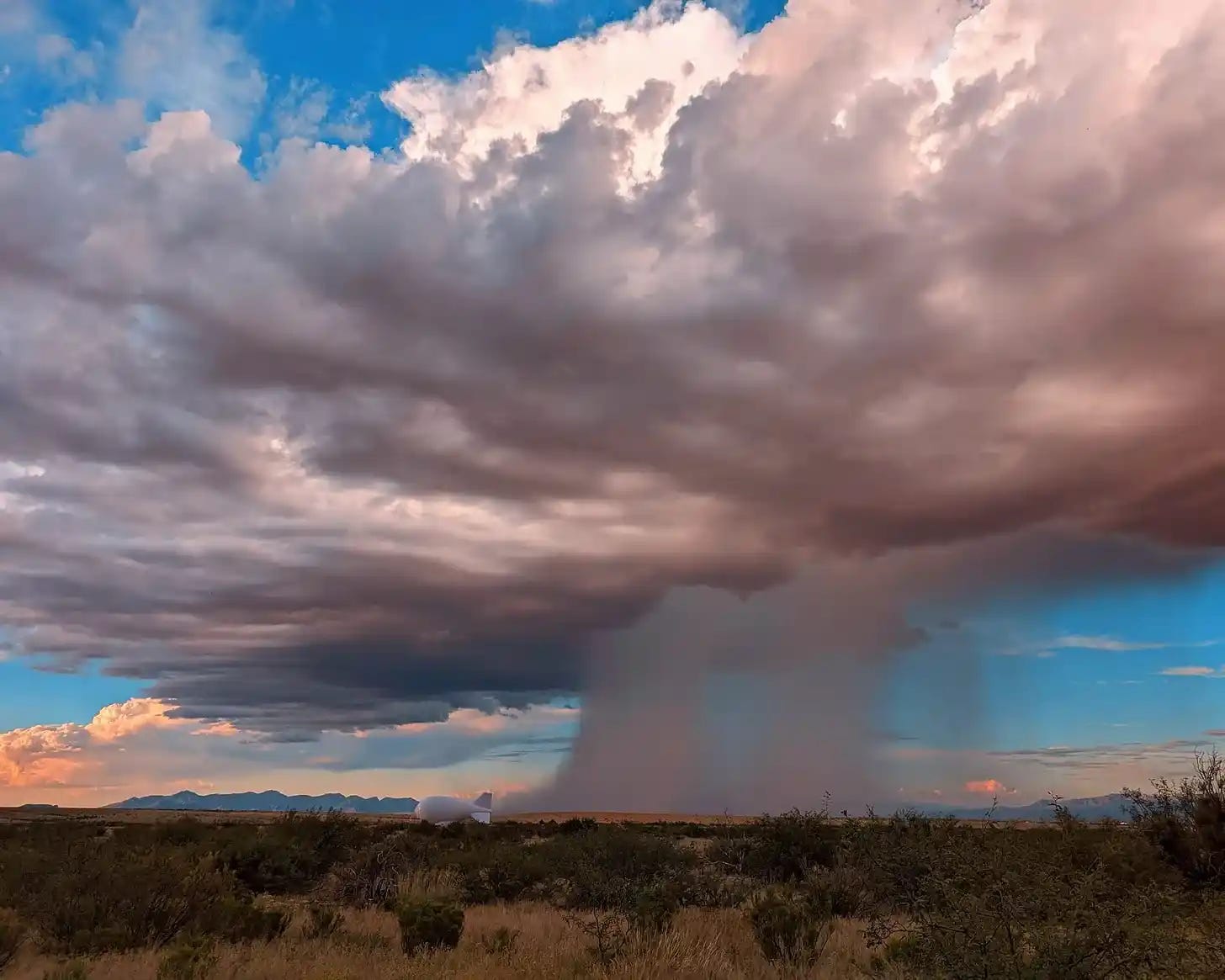
Must be nice to get paid to lie
Yep, it sure is! 😏
I first became a weatherman in 1989 when I hitchhiked to the Air Force recruiter’s office. Since then, I’ve had (cumulatively) a couple of years of schooling and three and a half decades of experience.
But guess what?
Some days I still have no idea why Mother Nature does what she does.

All this to say, I suppose I can’t blame you if you don’t trust me.
And you’d have plenty of company …
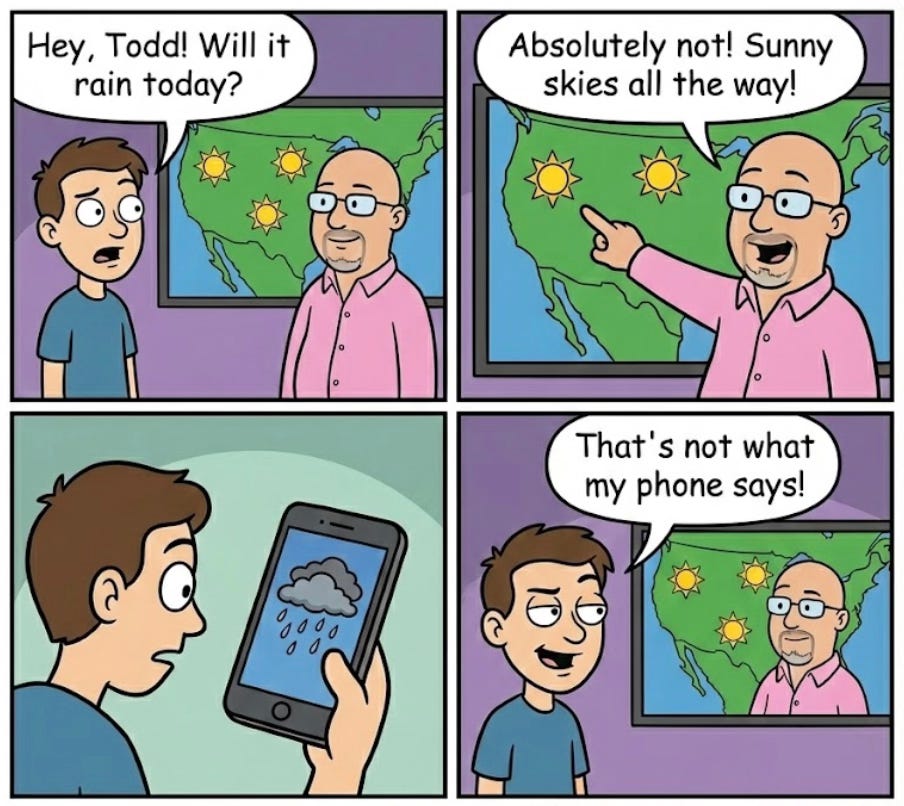
I can’t tell you how many times that scene above has been repeated over the years. And often the guy with the phone is one my own friends or family. 🥸
It kind of raises the question though …
Why do people trust their phones more than they trust me?
If you’re one of those people, I have some potentially disappointing news for you …
Your phone “Lies” too!
It just does it with significantly more confidence.
Seriously.
I’ve had people look at their phones, then tell me (with a straight face):
“It’s going to start raining at 3:22 pm and stop at 4:11”
Then they make plans based on this information.
lol, but I’m a liar?
Actually, sometimes I do get it totally wrong.
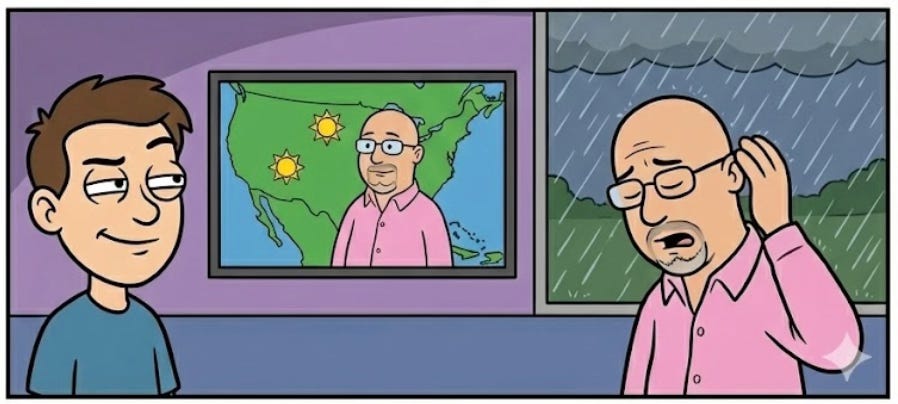
But I didn’t lie.
In my experience, the art of weather forecasting can be summed up as:
Making an educated guess based on the information you have at the time.
Here’s the tricky part though …
The information we’re using to formulate our guess is constantly changing.
This is part of the reason why we communicate in percentages and probabilities.
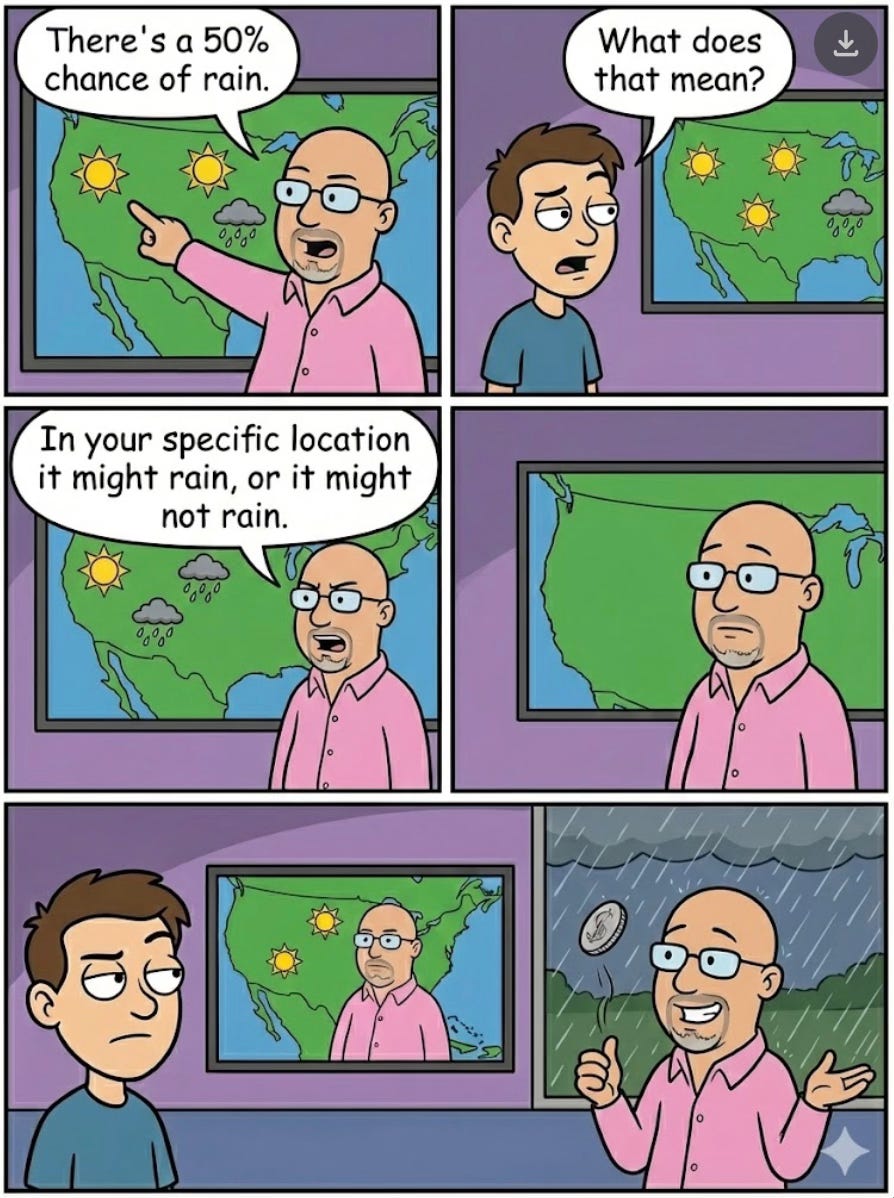
Okay, there’s a bit more to it than that.
We don’t always flip a coin.
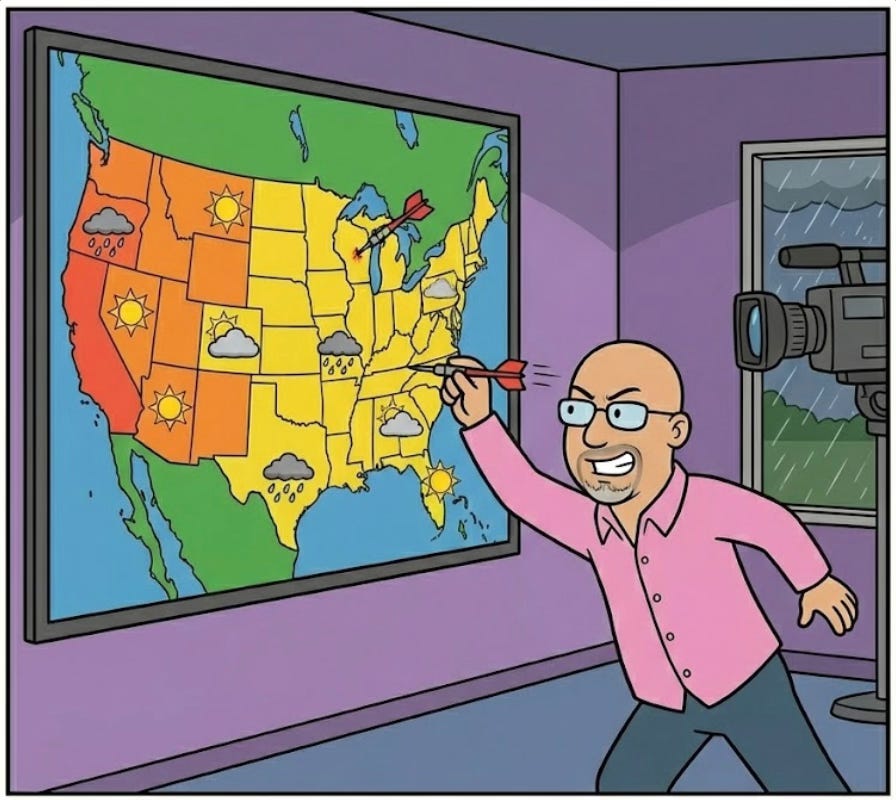
Sometimes we throw darts at the wall. 😎
Let’s end on a serious note.
Here’s the science (a simple breakdown of the complex math behind your daily forecast) …
What Does a “50% Chance of Rain” Really Mean?
The Official Definition
The National Weather Service defines a “50% chance of rain” (or any percentage) in a very precise way:
It is the statistically calculated probability that at least 0.01 inches of rain will fall at any given point in the forecast area within the forecast time period.
To come up with this number, forecasters don’t just shrug and flip a coin. They use a formula that combines two factors:
Confidence: How certain are they that rain will develop somewhere in the area?
Coverage: How much of the area do they expect the rain to cover if it does develop?
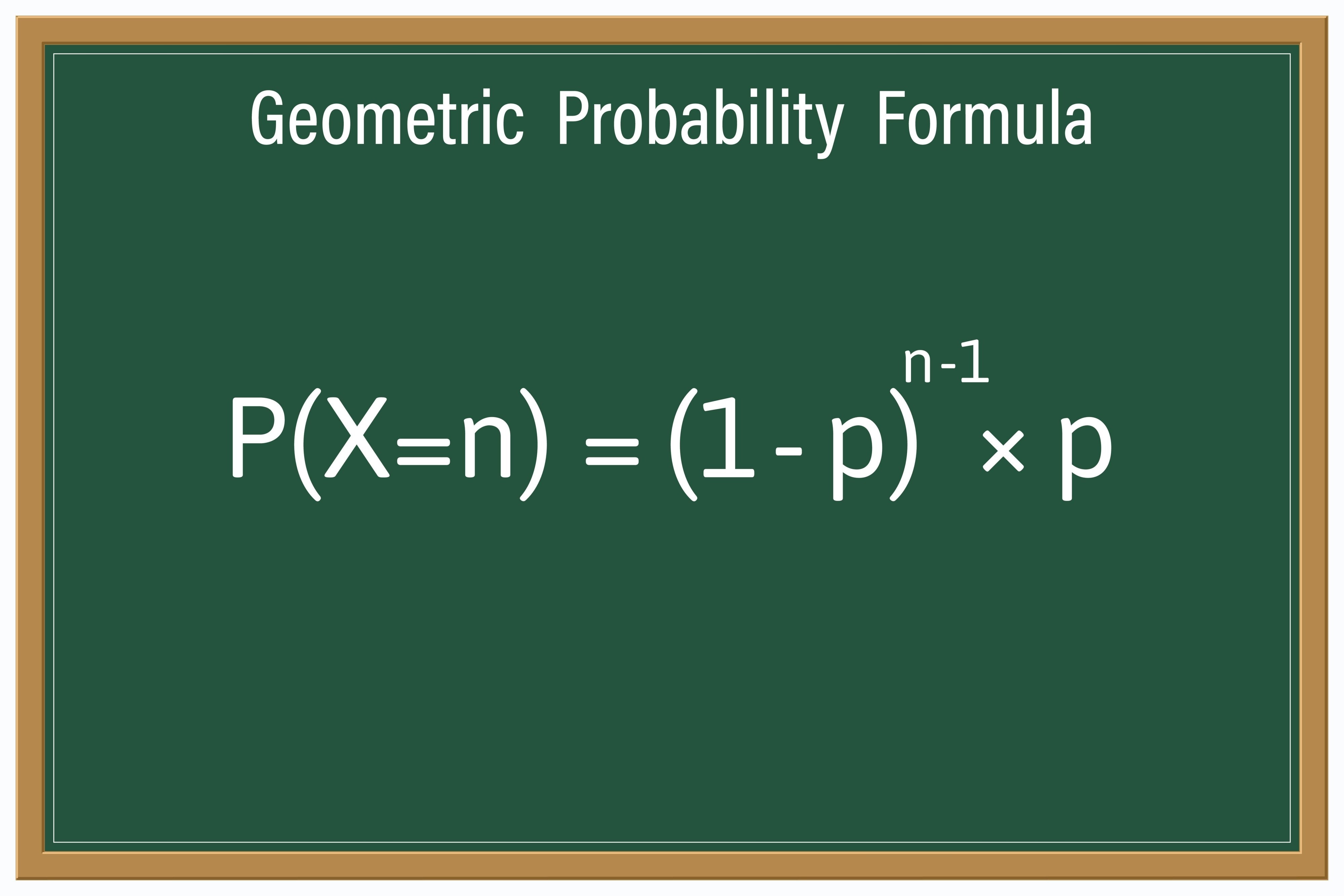
The formula is: PoP = Confidence x Areal Coverage
One Forecast, Two Very Different Stories
This is where it gets interesting. A forecaster can arrive at a 50% forecast in two completely different ways. This is the most common source of confusion.
Scenario A: The Scattered Storm
The Setup: The forecaster is 100% certain that pop-up thunderstorms will form in the afternoon.
The Catch: These storms will be scattered and small, so they will only cover about 50% of the city.
The Math: 100% Confidence x 50% Coverage = 50% PoP
Scenario B: The Big “If”
The Setup: A massive, organized rain system is moving towards your city. If it hits, it will cover 100% of the area.
The Catch: The forecaster is only 50% sure the system will hold together and reach the city at all.
The Math: 50% Confidence x 100% Coverage = 50% PoP
In both cases, the forecast is a “50% chance of rain.” But in Scenario A, you have a 100% chance of seeing rain somewhere in the area, while in Scenario B, there’s a 50% chance no one will see a drop.
What “50% Chance of Rain” Does NOT Mean
Let’s clear up the most common myths once and for all.
MYTH: It means it will rain for 50% of the day (e.g., 12 hours out of 24).
MYTH: It means that 50% of the forecast area will definitely get wet. (This is only true if the forecaster has 100% confidence).
MYTH: It means the forecaster has no idea and is just guessing.
So that’s the Scoop
Now you know how weather forecasting really works.
But it’s okay. I understand that most of you still imagine this is how I do my job:
Your Turn: What's the worst 'failed' forecast you ever planned a wedding or a picnic around? Tell me your 'weatherman lied' stories in the comments!


Think someone else might enjoy this post?